Inland Revenue (Amendment) Act, No. 11 of 2026 – Key Tax Changes Every Sri Lankan Taxpayer Should Know
Published by eFiling Tax Consultants
The Inland Revenue (Amendment) Act, No. 11 of 2026, certified on 3 June 2026, introduces significant changes to Sri Lanka’s income tax framework. These amendments affect individuals, businesses, employers, investors, professionals, and withholding agents.
The Inland Revenue Department (IRD) has also issued Notice SEC/PN/IT/2026/02 explaining the practical implementation of these amendments.
This article summarizes the key changes, explains who is affected, and outlines the actions taxpayers should consider.
Quick Overview of the Major Changes
The amendment introduces changes relating to:
- Motor vehicle capital gains
- Cash transaction restrictions
- Government donations
- Life insurance proceeds
- Unit trusts and mutual funds
- Tax residency rules
- Withholding Tax (WHT)
- Quarterly income tax instalments
- Income tax return filing obligations
- Taxpayer Identification Number (TIN)
- Capital Gains Tax rates
- Enhanced Capital Allowances
- Interest waivers for outstanding taxes
Let’s look at each amendment in simple terms.
1. Motor Vehicle Gains Are No Longer Taxable in Certain Cases
From 1 April 2024, gains from selling a motor vehicle are not treated as taxable “Other Income” if the vehicle:
- is not trading stock; and
- is not a depreciable business asset eligible for capital allowances.
Similarly, any loss on the disposal of such a vehicle is not deductible.
Example
If you sell your privately owned car for more than you originally paid, the gain is generally not subject to income tax under these rules.
Who is affected?
- Individual taxpayers
- Private vehicle owners
2. Large Cash Payments Continue to Face Tax Restrictions
Businesses should avoid making payments of LKR 500,000 or more in cash.
To claim a tax deduction, payments should generally be made through approved banking channels such as:
- Account payee cheques
- Bank drafts
- Credit cards
- Debit cards
- Electronic bank transfers
- Cash deposits made directly into the supplier’s bank account
Otherwise, the expense may not be deductible for income tax purposes, subject to specified exceptions.
Practical Tip
Maintain proper banking records for all significant business payments.
3. Gifts to the Government or State Universities Receive Tax Relief
Where an asset is donated to:
- the Government of Sri Lanka; or
- a university established under the Universities Act,
the transfer is treated as occurring at the asset’s net cost, preventing a taxable gain from arising.
4. Government Donations Can Be Carried Forward
If a qualifying donation to the Government or a Government-established fund cannot be fully deducted in one year, the unused amount may now be carried forward to future years.
This provides greater flexibility for taxpayers making substantial charitable contributions.
5. Life Insurance Benefits Receive Greater Tax Certainty
Amounts received under qualifying life insurance policies are generally excluded from assessable income when received:
- upon the death of the insured,
- at policy maturity, or
- on policy surrender,
subject to the statutory exceptions.
6. New Rules for Unit Trusts and Mutual Funds
Unit trusts and mutual funds must issue annual certificates to investors detailing:
- taxable income,
- exempt income,
- withholding tax deducted, and
- other prescribed information.
Failure to comply may result in the fund being taxed as a company.
7. Expanded Recognition of Approved Charitable Institutions
Certain healthcare organizations working with Government healthcare or education services may qualify as approved charitable institutions.
Donations to qualifying institutions may be treated as qualifying payments under the Inland Revenue Act.
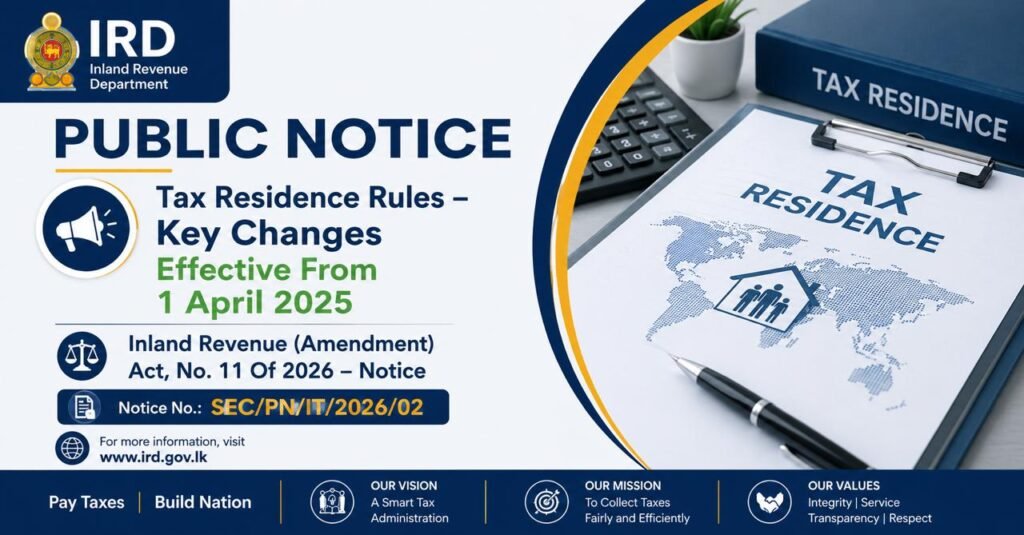
8. Important Changes to Tax Residency Rules
Click to see. The amendments clarify several residency rules, including:
- treatment of individuals working abroad,
- holders of Investor Category Residence Visas, and
- certain foreign nationals employed on Sri Lankan ships.
These changes are particularly relevant for expatriates and internationally mobile employees.
9. Export-Related Expenses
Certain expenses relating to exports of goods or services may now be deducted directly from domestic-source income under the amended provisions.
10. Major Withholding Tax (WHT) Changes
The amendment introduces several important WHT updates.
These include:
- procedures for gem auction withholding tax,
- self-declarations for certain bank interest recipients,
- additional professions subject to 5% WHT,
- annual withholding statements, and
- mandatory issuance of withholding certificates.
Professionals such as advisers, writers, photographers, social media specialists, IT specialists, coaches, translators, beauticians, electricians, dentists, veterinarians, and many others may now fall within these provisions where the statutory conditions are met.
11. Quarterly Income Tax Instalments Simplified
The requirement to submit a Statement of Estimated Tax (SET) has been removed.
Quarterly instalments will generally be based on the previous year’s tax liability, subject to adjustments in specified situations.
12. Filing Income Tax Returns
Certain employees whose only income is employment income fully subject to APIT may no longer need to maintain an income tax file or file a return, provided the statutory conditions are satisfied.
Additional provisions apply to senior citizens and Port City businesses.
13. Relief for Arrears of Salary
Employees receiving arrears due to reinstatement, promotions with retrospective effect, or similar situations may qualify for tax relief under the new provisions.
14. Broader Information Sharing
The Commissioner-General may disclose taxpayer information to specified public authorities for purposes permitted by law.
15. Expanded TIN Requirements
Companies must register within 30 days of incorporation.
A Taxpayer Identification Number (TIN) is also required for various activities including:
- opening bank accounts,
- registering businesses,
- registering motor vehicles,
- land registrations,
- obtaining credit cards, and
- certain company share transfers,
where applicable under the Act.
16. Reduced Risk of Additional Assessments
Taxpayers meeting specified conditions—including filing returns declaring at least 120% of the previous year’s tax liability and providing the required affidavit—may benefit from protection against amended or additional assessments for that year.
17. Refunds Under Cash Basis Accounting
Taxpayers using the cash basis of accounting may claim refunds of excess income tax where income is later refunded because a contract is cancelled or varied, provided claims are made within the prescribed period.
18. Stronger Recovery and Enforcement Measures
The amendments strengthen tax recovery procedures, introduce revised court processes, and clarify prosecution procedures for non-compliance.
19. Capital Gains Tax Rates Revised
Effective 3 June 2026, the new Capital Gains Tax rates are:
| Taxpayer | Rate |
|---|---|
| Individuals | 15% |
| Partnerships | 15% |
| Trusts | 30% |
| Unit Trusts | 30% |
| NGOs | 30% |
20. Enhanced Capital Allowance (ECA)
Businesses investing more than USD 250,000 in qualifying depreciable assets for a new business undertaking in Sri Lanka may claim a 100% Enhanced Capital Allowance from 1 April 2026, subject to the statutory conditions.
21. Interest Waiver Opportunity
Interest on late payments and underpayments of certain taxes may be waived up to the 2024/2025 Year of Assessment, provided the principal tax is paid in full by 2 December 2026 or has already been settled.
This presents an opportunity for taxpayers with outstanding liabilities to regularize their tax affairs.
What Should Taxpayers Do Now?
Whether you are an individual, employer, investor, or business owner, these amendments may affect your tax obligations.
You should consider:
- Reviewing your tax compliance procedures.
- Updating payment methods for business expenses.
- Confirming whether you are subject to the revised WHT rules.
- Checking whether your TIN registration is complete.
- Reviewing quarterly tax payment calculations.
- Assessing eligibility for capital allowances or the interest waiver.
- Seeking professional advice before implementing tax planning strategies.
Need Professional Tax Advice?
The Inland Revenue (Amendment) Act, No. 11 of 2026 introduces several technical changes that require careful interpretation and timely compliance.
At eFiling Tax Consultants, we help individuals and businesses stay compliant while identifying legitimate tax planning opportunities.
Our services include:
- Income Tax Advisory
- Corporate Tax Compliance
- VAT Registration and Advisory
- Withholding Tax Compliance
- Tax Health Checks
- Payroll Tax Services
- Company Registration
- Inland Revenue Department Representation
Contact eFiling Tax Consultants
📍 Office: No. 02, New Shopping Complex, Yatiyana, Matara 81034, Sri Lanka
📞 +94 71 193 4452
Disclaimer: This article provides general information based on the Inland Revenue (Amendment) Act, No. 11 of 2026 and IRD Notice SEC/PN/IT/2026/02. It is not legal or tax advice. Tax outcomes depend on individual circumstances, and professional advice should be obtained before acting on any information contained herein.